Linear Regression Estimation with bayesDP
Donnie Musgrove
2026-06-25
Source:vignettes/bdplm-vignette.Rmd
bdplm-vignette.RmdIntroduction
The purpose of this vignette is to introduce the bdplm
function. bdplm is used for estimating posterior samples in
the context of linear regression for clinical trials where an
informative prior is used. In the parlance of clinical trials, the
informative prior is derived from historical data. The weight given to
the historical data is determined using what we refer to as a discount
function. There are three steps in carrying out estimation:
Estimation of the historical data weight, denoted , via the discount function
Estimation of the posterior distribution of the current data, conditional on the historical data weighted by
Estimation of the posterior treatment effect, i.e., treatment versus control
Throughout this vignette, we use the terms current,
historical, treatment, and
control. These terms are used because the model was
envisioned in the context of clinical trials where historical data may
be present. Because of this terminology, there are 4 potential sources
of data:
Current treatment data: treatment data from a current study
Current control data: control (or other treatment) data from a current study
Historical treatment data: treatment data from a previous study
Historical control data: control (or other treatment) data from a previous study
If only treatment data is input, the function considers the analysis a one-arm trial. If treatment data + control data is input, then it is considered a two-arm trial.
Note that the bdplm function currently only has
support for a two-arm clinical trial where current and historical
treatment and current and historical control data are all
present.
Linear Regresion Model Background
Before we get into our estimation scheme, we will briefly describe
our implementation of the linear regression model. The linear regression
model implementation, via bdplm, serves as an advanced
companion to the bdpnormal model. With the
bdpnormal model, we are interested in comparing mean
outcomes via the probability that the mean values from treatment and
control arms are not equivalent. When covariate adjustments are needed,
bdpnormal is no longer a viable solution. Thus,
bdplm allows analysts to adjust the treatment and control
arm comparison for covariate effects.
The analysis model of interest has the form where indicates whether observation is in the treatment arm, is the intercept, is the treatment effect, is the th covariate with corresponding covariate effect, , and is the unknown error variance.
Let . Then, in order to place prior values on the treatment effect, we reparameterize the linear regression model as where now indicates whether observation is in the control arm, i.e., . It is then straightforward to show that and .
In this reparameterization,
and
are the control and treatment arm means evaluated at covariate
.
When the covariates are not centered, these arm-mean parameters become
strongly correlated and their (historical) standard errors are
extrapolation errors at covariate
.
Because the historical information is incorporated through an
independent (diagonal) prior on each arm mean, this correlation and the
inflated standard errors distort the borrowing of historical data. To
avoid this, bdplm automatically mean-centers each covariate
on its pooled (current plus historical) mean before fitting, so that
and
are the arm means at the average covariate value. The intercept is then
back-transformed onto the original covariate scale: with pooled
covariate means
and estimated covariate effects
,
the reported intercept is
,
so
is still the control mean at covariate
on the original scale. The treatment effect
and the covariate effects are unchanged by centering, and the estimates
are invariant to a location shift of any covariate. Users therefore do
not need to center covariates themselves.
Estimation of the historical data weight
In the first estimation step, the historical data weight is estimated. In the case of a two-arm trial, where both treatment and control data are available, an value is estimated separately for each of the treatment and control arms. Of course, historical treatment or historical control data must be present, otherwise is not estimated for the corresponding arm.
When historical data are available, estimation of is carried out as follows. Let and denote the current and historical data, respectively. The following linear regression model is then fit to the data: where indicates whether observation is historical. With vague priors on each parameter, we estimate the posterior probability that by first computing . Then, we calculate the posterior probability as
Finally, for a discount function, denoted , is computed as where may be one or more parameters associated with the discount function and scales the weight by a user-input maximum value. More details on the discount functions are given in the discount function section below.
There are several model inputs at this first stage. First, the user
can select fix_alpha=TRUE and force a fixed value of
(at the alpha_max input), as opposed to estimation via the
discount function.
An alternate Monte Carlo-based estimation scheme of
has been implemented, controlled by the function input
method="mc". Here, instead of treating
as a fixed quantity,
is treated as random. First,
,
is computed as
where
is an estimate of the standard deviation of
and
is the
th
quantile of a standard normal (i.e., the pnorm R function).
Next,
is used to construct
via the discount function. Since the values
and
are computed at each iteration of the Monte Carlo estimation scheme,
is computed at each iteration of the Monte Carlo estimation scheme,
resulting in a distribution of
values.
Discount function
There are currently three discount functions implemented throughout
the bayesDP package. The discount function is specified
using the discount_function input with the following
choices available:
identity(default): Identity.weibull: Weibull cumulative distribution function (CDF);scaledweibull: Scaled Weibull CDF;
First, the identity discount function (default) sets the discount weight .
Second, the Weibull CDF has two user-specified parameters associated
with it, the shape and scale. The default shape is 3 and the default
scale is 0.135, each of which are controlled by the function inputs
weibull_shape and weibull_scale, respectively.
The form of the Weibull CDF is
The third discount function option is the Scaled Weibull CDF. The
Scaled Weibull CDF is the Weibull CDF divided by the value of the
Weibull CDF evaluated at 1, i.e.,
Similar to the Weibull CDF, the Scaled Weibull CDF has two
user-specified parameters associated with it, the shape and scale, again
controlled by the function inputs weibull_shape and
weibull_scale, respectively.
Using the default shape and scale inputs, each of the discount
functions are shown below.
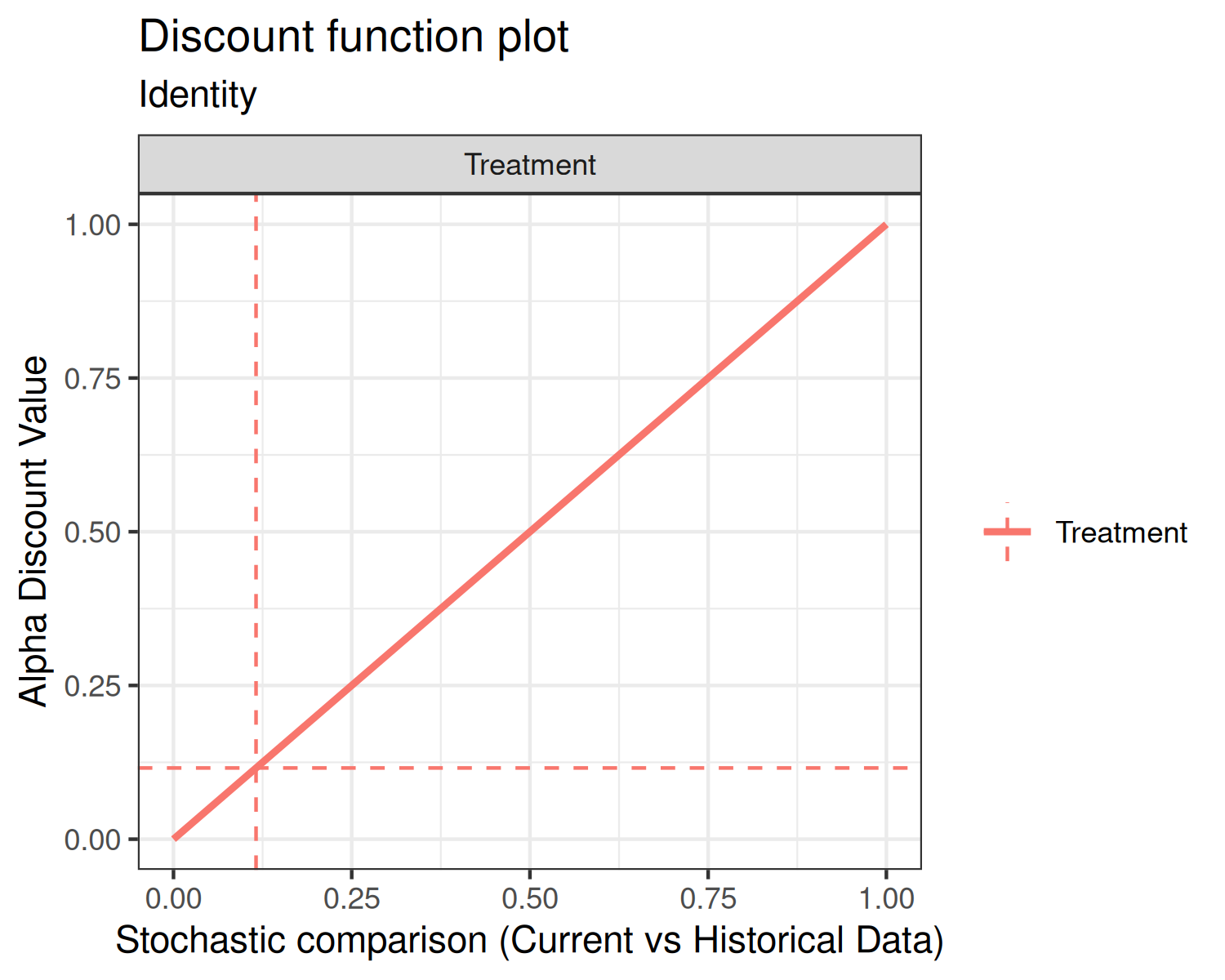
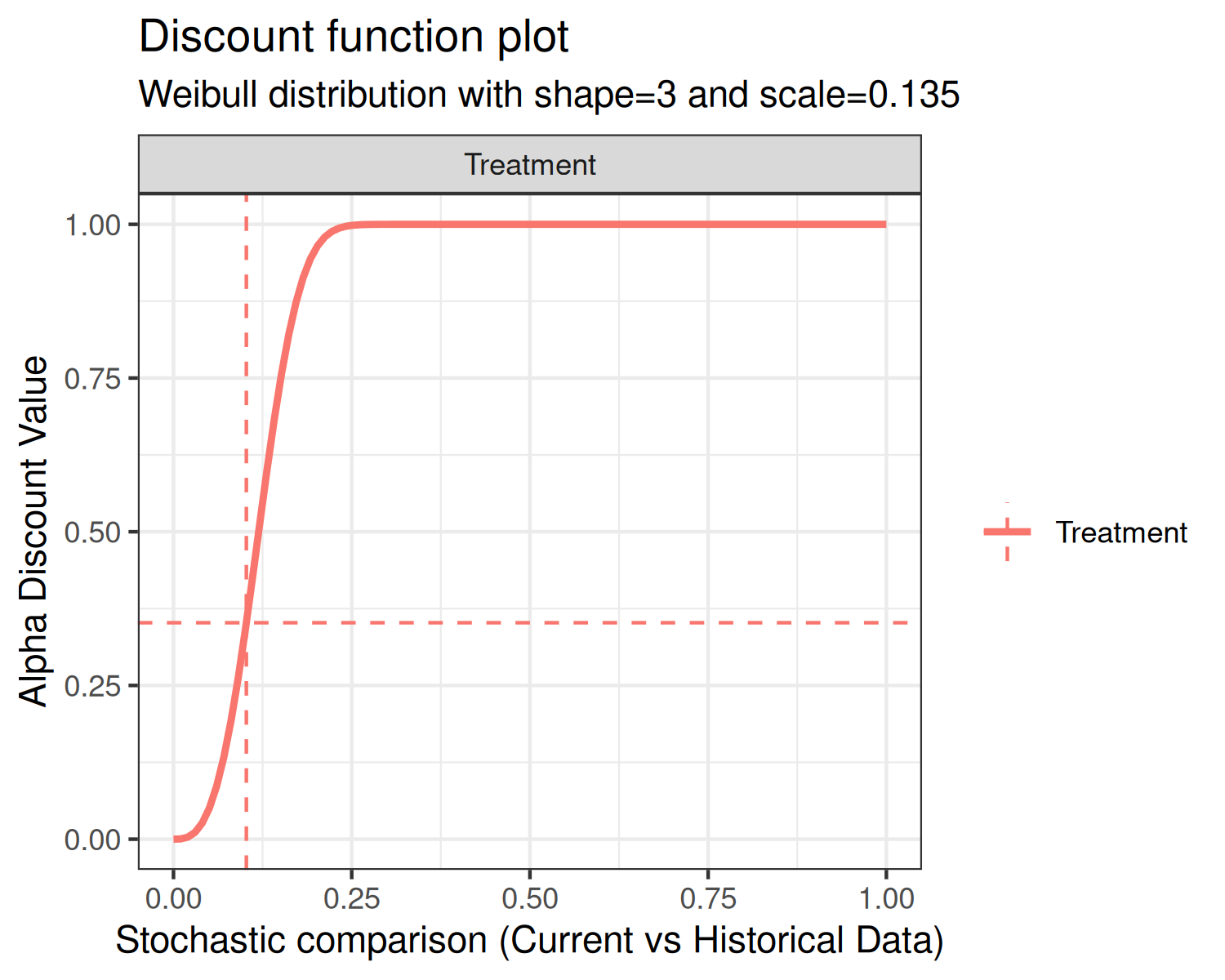
In each of the above plots, the x-axis is the stochastic comparison between current and historical data, which we’ve denoted . The y-axis is the discount value that corresponds to a given value of .
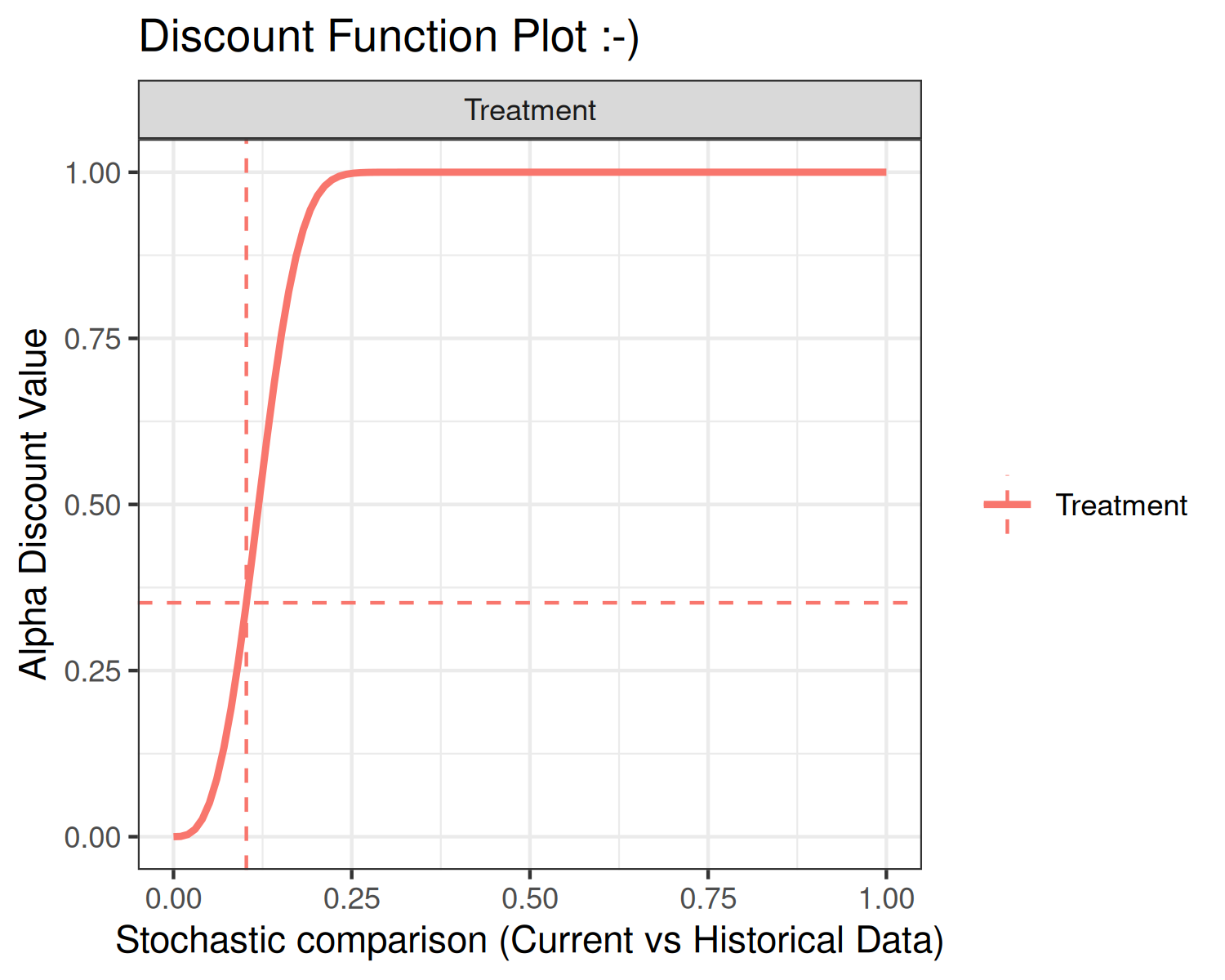
An advanced input for the plot function is print. The
default value is print = TRUE, which simply returns the
graphics. Alternately, users can specify print = FALSE,
which returns a ggplot2 object. Below is an example using
the discount function plot:
Estimation of the posterior distribution of the current data, conditional on the historical data
This section details the modeling scheme used to estimate the parameters of the linear regression model. In vector notation the model can be written $$ \begin{array}{rcl} \mathbf{y} & \sim & \mathcal{N}\left(\mathbf{X}\boldsymbol{\beta},\thinspace\boldsymbol{\Sigma}_{y}\right),\\ \\ \boldsymbol{\beta} & \sim & \mathcal{N}\left(\boldsymbol{\mu}_{\beta},\thinspace\boldsymbol{\Sigma}_{\beta}\right), \end{array} $$ where and are known and . Here, and are the prior means of the control and treatment effects, respectively, while are the prior means of the covariate effects. Likewise, and are the prior variances of the control and treatment effects (weighted by the discount function result ), respectively, while are the prior variances of the remaining covariate effects.
Using what we refer to as the Gelman parameterization (see Gelman’s Bayesian Data Analysis, 3rd edition, chapter 14, for more information), the model can be reparameterized to improve computational efficiency. First, write $$ \mathbf{y}_{\ast}=\left(\begin{array}{c} \mathbf{y}\\ \boldsymbol{\mu}_{\beta} \end{array}\right),\thinspace\mathbf{X}_{\ast}=\left(\begin{array}{c} \mathbf{X}\\ \mathbf{I}_m \end{array}\right),\thinspace\boldsymbol{\Sigma}_{\ast}=\left(\begin{array}{cc} \boldsymbol{\Sigma}_y & 0\\ 0 & \boldsymbol{\Sigma}_{\beta} \end{array}\right). $$ Then, the Gelman parameterization has the form The estimate of is computed as where This estimate of is the posterior mean and relies on an unknown parameter, . The marginal posterior distribution of is found as Notice that both and contain . Thus, this marginal posterior of does not have a known distribution. We resort to a grid search of where 100s or 1000s of values of are proposed, on a grid, and the proposed values are sampled with probability proportional to the likelihood evaluated at the proposal.
Finally, values of sampled from the posterior distribution are then used to sample values of from
Inputting Data
The data inputs for bdplm are via dataframes
data and data0 that must have matching column
names. Each dataframe must have a binary column named
treatment that indicates treatment vs. control. If no
covariate columns are present, users should use the
bdpnormal function. Currently, both data and
data0 must be input since only a two-armed clinical trial
with historical data has been implemented.
Examples
Two-arm trial
Throughout this package, we define a two-arm trial as an analysis where a current and/or historical control arm is present. Below we simulate a dataframe and view the estimates of the model fit.
set.seed(42)
### Simulate  data
# Sample sizes
n_t  <- 30     # Current treatment sample size
n_c  <- 30     # Current control sample size
n_t0 <- 80     # Historical treatment sample size
n_c0 <- 80     # Historical control sample size

# Treatment group vectors for current and historical data
treatment   <- c(rep(1,n_t), rep(0,n_c))
treatment0  <- c(rep(1,n_t0), rep(0,n_c0))

# Simulate a covariate effect for current and historical data
x  <- rnorm(n_t+n_c, 1, 5)
x0 <- rnorm(n_t0+n_c0, 1, 5)

# Simulate outcome:
# - Intercept of 10 for current and historical data
# - Treatment effect of 31 for current data
# - Treatment effect of 30 for historical data
# - Covariate effect of 3 for current and historical data
Y  <- 10 + 31*treatment  + x*3 + rnorm(n_t+n_c,0,5)
Y0 <- 10 + 30*treatment0 + x0*3 + rnorm(n_t0+n_c0,0,5)

# Place data into separate treatment and control data frames and
# assign historical = 0 (current) or historical = 1 (historical)
df_ <- data.frame(Y=Y, treatment=treatment, x=x)
df0 <- data.frame(Y=Y0, treatment=treatment0, x=x0)

# Fit model using default settings
fit <- bdplm(formula=Y ~ treatment+x, data=df_, data0=df0,
             method="fixed")

summary(fit)
##
## Call:
## bdplm(formula = Y ~ treatment + x, data = df_, data0 = df0, method = "fixed")
##
## Residuals:
## Min 1Q Median 3Q Max
## -10.891 -0.514 2.818 6.749 12.574
##
## Coefficients:
## Estimate Std. Error
## (Intercept) 9.8820 0.4585
## treatment 31.2838 0.9207
## x 3.0118 0.1077
##
## Discount function value (alpha):
## treatment control
## 0.07 0.99
##
## Residual standard error: 4.7541
print(fit)##
## Call:
## bdplm(formula = Y ~ treatment + x, data = df_, data0 = df0, method = "fixed")
##
##
## Coefficients:
## (Intercept) treatment x
## 9.882 31.284 3.012
##
##
## Discount function value (alpha):
## treatment control
## 0.07 0.99
#plot(fit) <-- Not yet implemented