Binomial Count Estimation with bayesDP
Donnie Musgrove
2026-06-25
Source:vignettes/bdpbinomial-vignette.Rmd
bdpbinomial-vignette.RmdIntroduction
The purpose of this vignette is to introduce the
bdpbinomial function. bdpbinomial is used for
estimating posterior samples from a Binomial event rate outcome for
clinical trials where an informative prior is used. In the parlance of
clinical trials, the informative prior is derived from historical data.
The weight given to the historical data is determined using what we
refer to as a discount function. There are three steps in carrying out
estimation:
Estimation of the historical data weight, denoted , via the discount function
Estimation of the posterior distribution of the current data, conditional on the historical data weighted by
If a two-arm clinical trial, estimation of the posterior treatment effect, i.e., treatment versus control
Throughout this vignette, we use the terms current,
historical, treatment, and
control. These terms are used because the model was
envisioned in the context of clinical trials where historical data may
be present. Because of this terminology, there are 4 potential sources
of data:
Current treatment data: treatment data from a current study
Current control data: control (or other treatment) data from a current study
Historical treatment data: treatment data from a previous study
Historical control data: control (or other treatment) data from a previous study
If only treatment data is input, the function considers the analysis a one-arm trial. If treatment data + control data is input, then it is considered a two-arm trial.
Estimation of the historical data weight
In the first estimation step, the historical data weight is estimated. In the case of a two-arm trial, where both treatment and control data are available, an value is estimated separately for each of the treatment and control arms. Of course, historical treatment or historical control data must be present, otherwise is not estimated for the corresponding arm.
When historical data are available, estimation of is carried out as follows. Let and denote the number of events and sample size of the current data, respectively. Similarly, let and denote the number of events and sample size of the historical data, respectively. Let and denote the rate parameters of a Beta distribution. Then, the posterior distributions of the event rates for current and historical data, under vague (flat) priors are
and
respectively. We next compute the posterior probability . Finally, for a discount function, denoted , is computed as where may be one or more parameters associated with the discount function and scales the weight by a user-input maximum value. More details on the discount functions are given in the discount function section below.
There are several model inputs at this first stage. First, the user
can select the discount function type via the
discount_function input (see below). Next, choosing
fix_alpha=TRUE forces a fixed value of
(at the alpha_max input), as opposed to estimation via the
discount function. In the next modeling stage, a Monte Carlo estimation
approach is used, requiring several samples from the posterior
distributions. Thus, the user can input a sample size greater than or
less than the default value of number_mcmc=10000. Finally,
the Beta rate parameters can be changed from the defaults of
(a0 and b0 inputs).
An alternate Monte Carlo-based estimation scheme of
has been implemented, controlled by the function input
method="mc". Here, instead of treating
as a fixed quantity,
is treated as random. Because
is recomputed at each Monte Carlo draw using a single pair of posterior
samples, the resulting sequence of
values can exhibit noticeable Monte Carlo variability. First,
,
is computed as
where
is the
th
quantile of a standard normal (i.e, the pnorm R function).
Here,
and
are estimates of the variances of
and
,
respectively. Next,
is used to construct
via the discount function. Since the values
and
are computed at each iteration of the Monte Carlo estimation scheme,
is computed at each iteration of the Monte Carlo estimation scheme,
resulting in a distribution of
values.
Discount function
There are currently three discount functions implemented throughout
the bayesDP package. The discount function is specified
using the discount_function input with the following
choices available:
identity(default): Identity.weibull: Weibull cumulative distribution function (CDF);scaledweibull: Scaled Weibull CDF;
First, the identity discount function (default) sets the discount weight .
Second, the Weibull CDF has two user-specified parameters associated
with it, the shape and scale. The default shape is 3 and the default
scale is 0.135, each of which are controlled by the function inputs
weibull_shape and weibull_scale, respectively.
The form of the Weibull CDF is
The third discount function option is the Scaled Weibull CDF. The
Scaled Weibull CDF is the Weibull CDF divided by the value of the
Weibull CDF evaluated at 1, i.e.,
Similar to the Weibull CDF, the Scaled Weibull CDF has two
user-specified parameters associated with it, the shape and scale, again
controlled by the function inputs weibull_shape and
weibull_scale, respectively.
Using the default shape and scale inputs, each of the discount
functions are shown below.
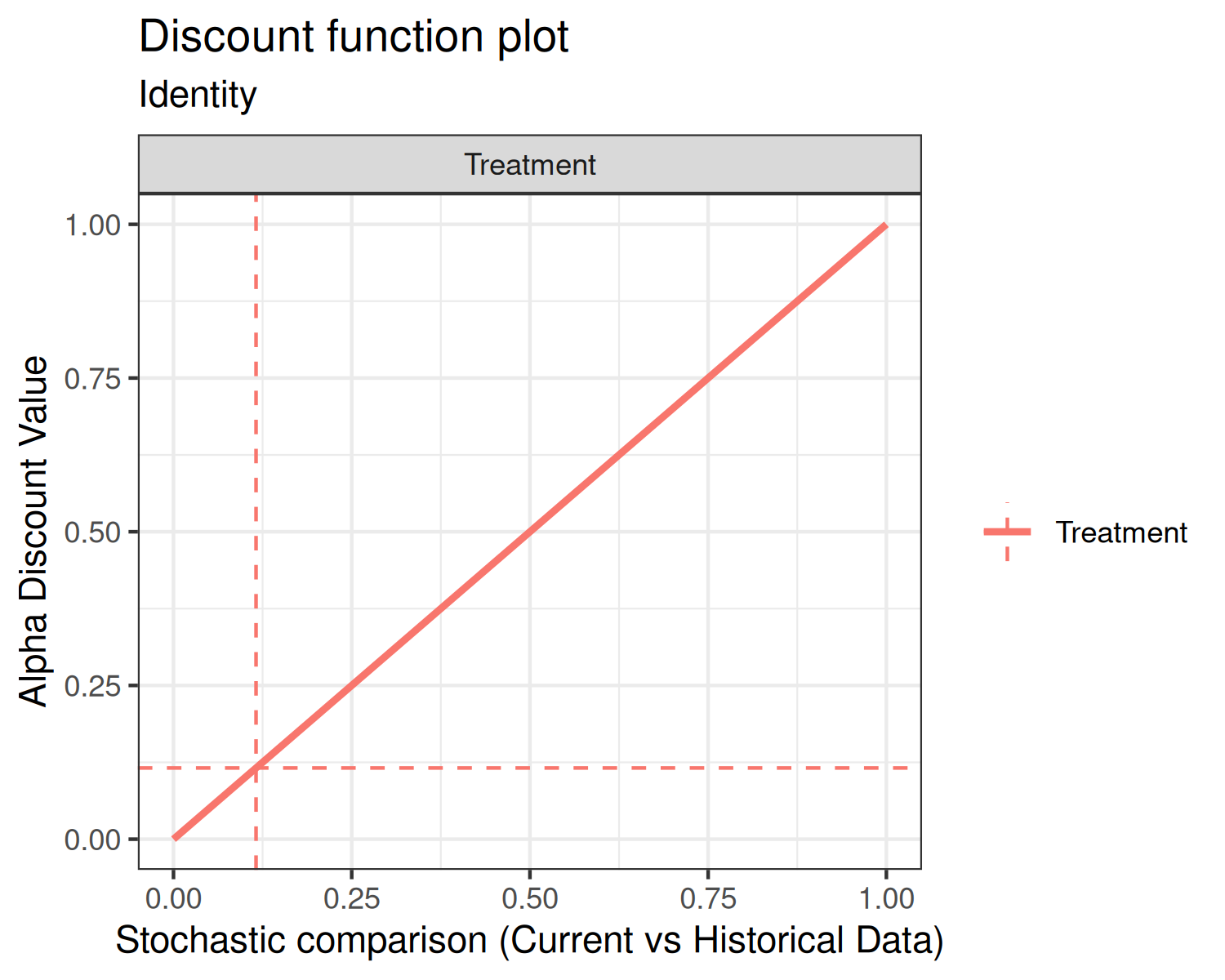
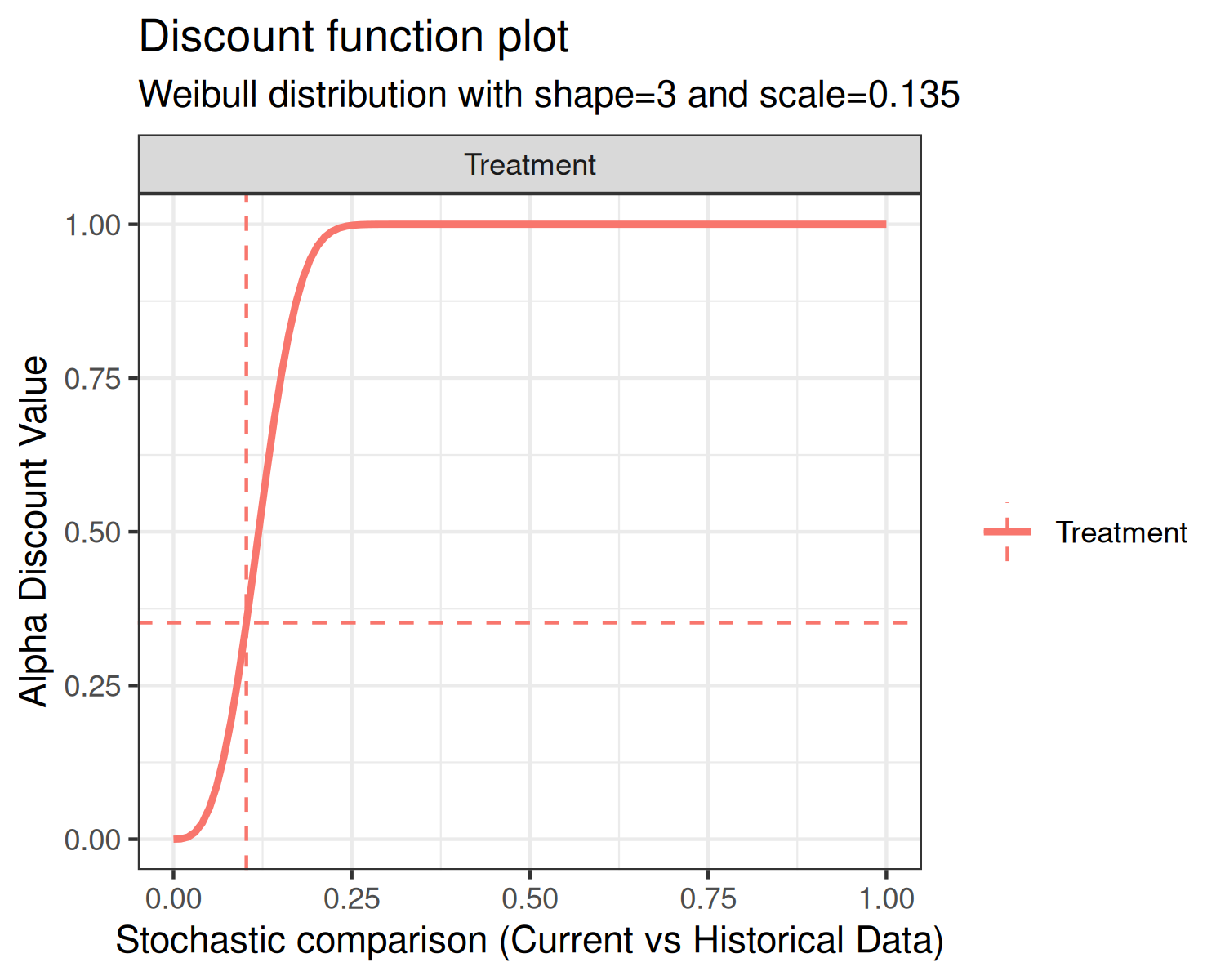
In each of the above plots, the x-axis is the stochastic comparison between current and historical data, which we’ve denoted . The y-axis is the discount value that corresponds to a given value of .
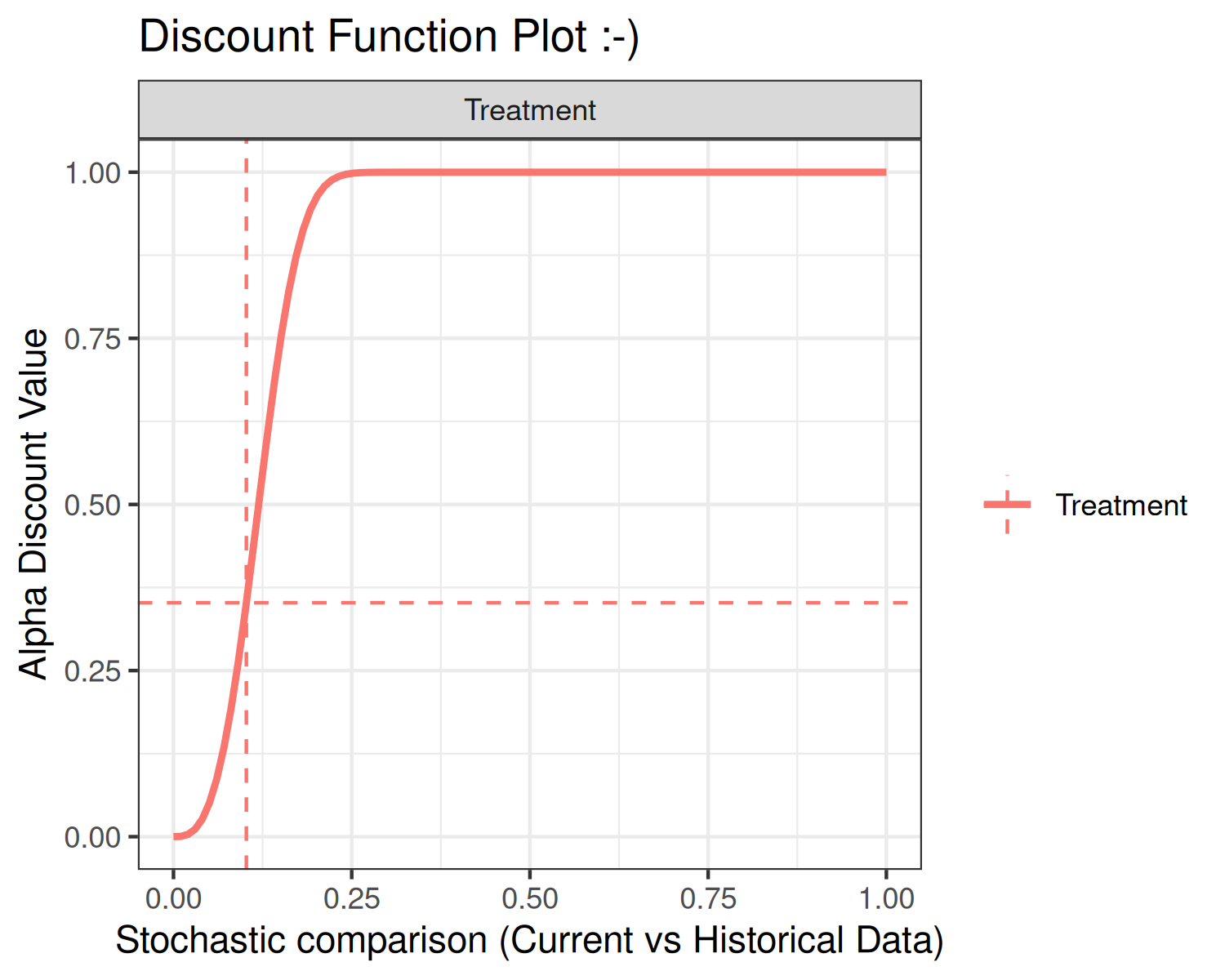
An advanced input for the plot function is print. The
default value is print = TRUE, which simply returns the
graphics. Alternately, users can specify print = FALSE,
which returns a ggplot2 object. Below is an example using
the discount function plot:
Estimation of the posterior distribution of the current data, conditional on the historical data
With
in hand, we can now estimate the posterior distribution of the current
data event rate. Using the notation of the previous section, the
posterior distribution is
At this model stage, we have in hand number_mcmc
simulations from the augmented event rate distribution. If there are no
control data, i.e., a one-arm trial, then the modeling stops and we
generate summaries of the posterior distribution of
.
Otherwise, if there are control data, we proceed to a third step and
compute a comparison between treatment and control data.
Estimation of the posterior treatment effect: treatment versus control
This step of the model is carried out on-the-fly using the
summary or print methods. Let
and
denote posterior event rate estimates of the treatment and control arms,
respectively. Currently, the implemented comparison between treatment
and control is the difference, i.e., summary statistics related to the
posterior difference:
.
In a future release, we may consider implementing additional comparison
types.
Inputting Data
The data inputs for bdpbinomial are y_t,
N_t, y0_t, N0_t,
y_c, N_c, y0_c, and
N0_c. The data must be input as (y,
N) pairs. For example, y_t, the number of
events in the current treatment group, must be accompanied by
N_t, the sample size of the current treatment group.
Historical data inputs are not necessary, but using this function would
not be necessary either.
At the minimum, y_t and N_t must be
input. In the case that only y_t and
N_t are input, the analysis is analogous to using
prop.test. Each of the following input combinations are
allowed:
- (
y_t,N_t) - one-arm trial - (
y_t,N_t) + (y0_t,N0_t) - one-arm trial - (
y_t,N_t) + (y_c,N_c) - two-arm trial - (
y_t,N_t) + (y0_c,N0_c) - two-arm trial - (
y_t,N_t) + (y0_t,N0_t) + (y_c,N_c) - two-arm trial - (
y_t,N_t) + (y0_t,N0_t) + (y0_c,N0_c) - two-arm trial - (
y_t,N_t) + (y0_t,N0_t) + (y_c,N_c) + (y0_c,N0_c) - two-arm trial
Examples
One-arm trial
Suppose we have historical data with y0_t=25 events out
of a sample size of N0_t=250 patients. This gives a
historical event rate of 0.1. Now, suppose we have current data with
y_t=15 events out of a sample size of N_t=200
patients, giving an event rate of 0.075. To illustrate the approach,
let’s first give full weight to the historical data. This is
accomplished by setting alpha_max=1 and
fix_alpha=TRUE as follows:
set.seed(42)
fit1 <- bdpbinomial(y_t       = 15,
                    N_t       = 200,
                    y0_t      = 25,
                    N0_t      = 250,
                    alpha_max = 1,
                    fix_alpha = TRUE,
                    method    = "fixed")
summary(fit1)
##
## One-armed bdp binomial
##
## Current treatment data: 15 and 200
## Historical treatment data: 25 and 250
## Stochastic comparison (p_hat) - treatment (current vs. historical data): 0.3664
## Discount function value (alpha) - treatment: 1
## 95 percent CI:
## 0.0663 0.1194
## sample estimates:
## 0.0902Based on the summary output of fit1, we can
see that the value of alpha was held fixed at 1. The
resulting (augmented) event rate was estimated at 0.0902 which is
approximately the event rate if we combined the historical and current
data together, i.e., (15 + 25) / (200 + 250) = 0.089. Note
that the print and summary methods result in
the same output.
Now, let’s relax the constraint on fixing alpha at 1.
We’ll also take this opportunity to describe the output of the plot
method.
set.seed(42)
fit1a <- bdpbinomial(y_t       = 15,
                     N_t       = 200,
                     y0_t      = 25,
                     N0_t      = 250,
                     alpha_max = 1,
                     fix_alpha = FALSE,
                     method    = "fixed")
summary(fit1a)
##
## One-armed bdp binomial
##
## Current treatment data: 15 and 200
## Historical treatment data: 25 and 250
## Stochastic comparison (p_hat) - treatment (current vs. historical data): 0.3664
## Discount function value (alpha) - treatment: 0.3664
## 95 percent CI:
## 0.0566 0.1211
## sample estimates:
## 0.085When alpha is not constrained to one, it is estimated
based on a comparison between the current and historical data. We see
that the stochastic comparison, p_hat, between historical
and control is 0.3664. Here, p_hat is the posterior
probability of the comparison between current and historical data. With
the present example, p_hat = 0.3664 implies that the
current and historical event rates are moderately different. The result
is that the weight given to the historical data is shrunk towards zero.
Thus, the estimate of alpha from the discount function is
0.3664, and the augmented posterior estimate of the event rate moves up
from 0.075 observed in the current data to a value closer to 0.089.
Many of the the values presented in the summary method
are accessible from the fit object. For instance, alpha is
found in fit1a$posterior_treatment$alpha_discount and
p_hat is located at
fit1a$posterior_treatment$p_hat. The
sample estimates and CI are computed at run-time. The
results can be replicated as:
## [1] 0.085
CI95_augmented <- round(quantile(fit1a$posterior_treatment$posterior, prob=c(0.025, 0.975)),4)
CI95_augmented
## 2.5% 97.5%
## 0.0566 0.1211Finally, we’ll explore the plot method.
plot(fit1a, type="posteriors")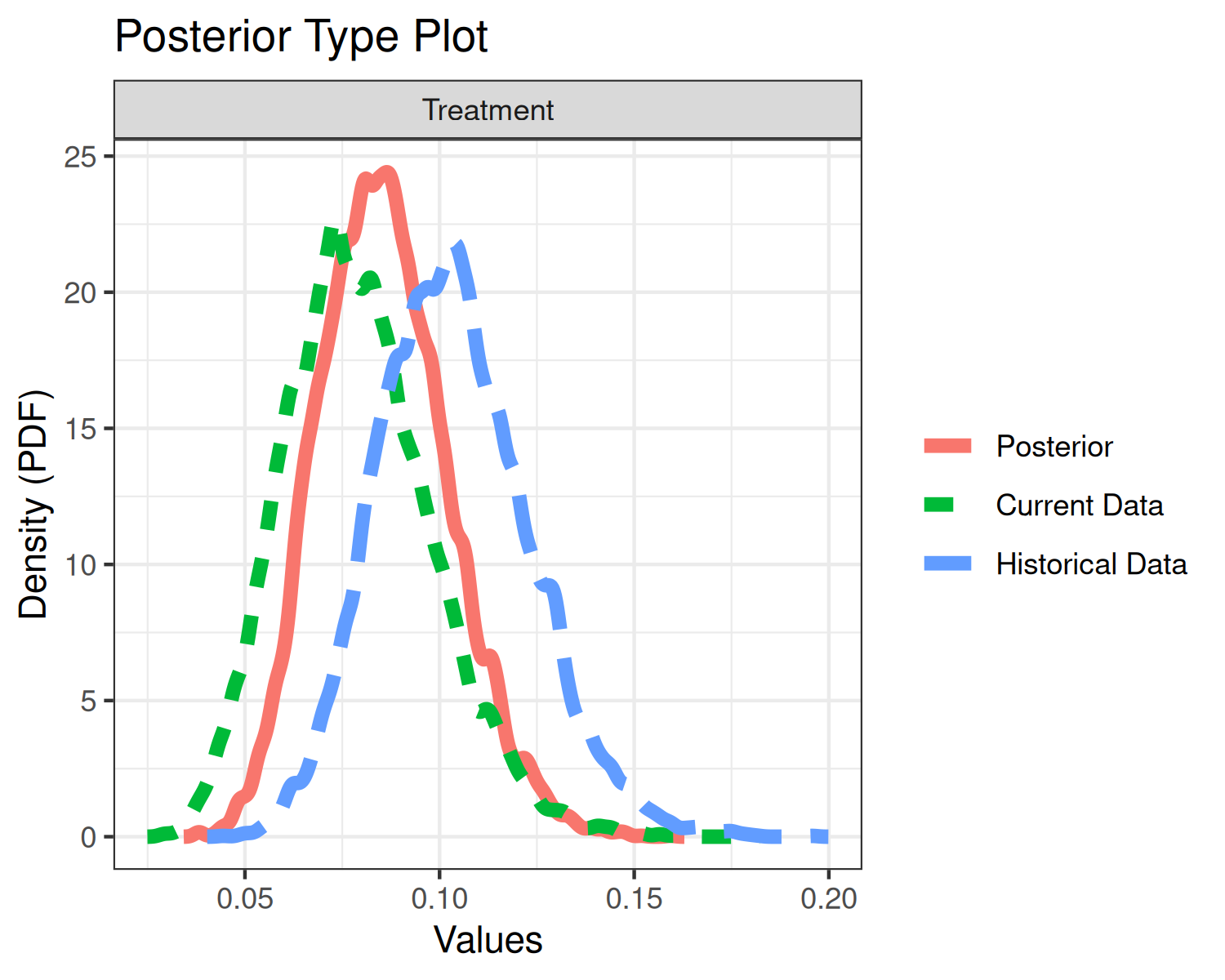
plot(fit1a, type="density")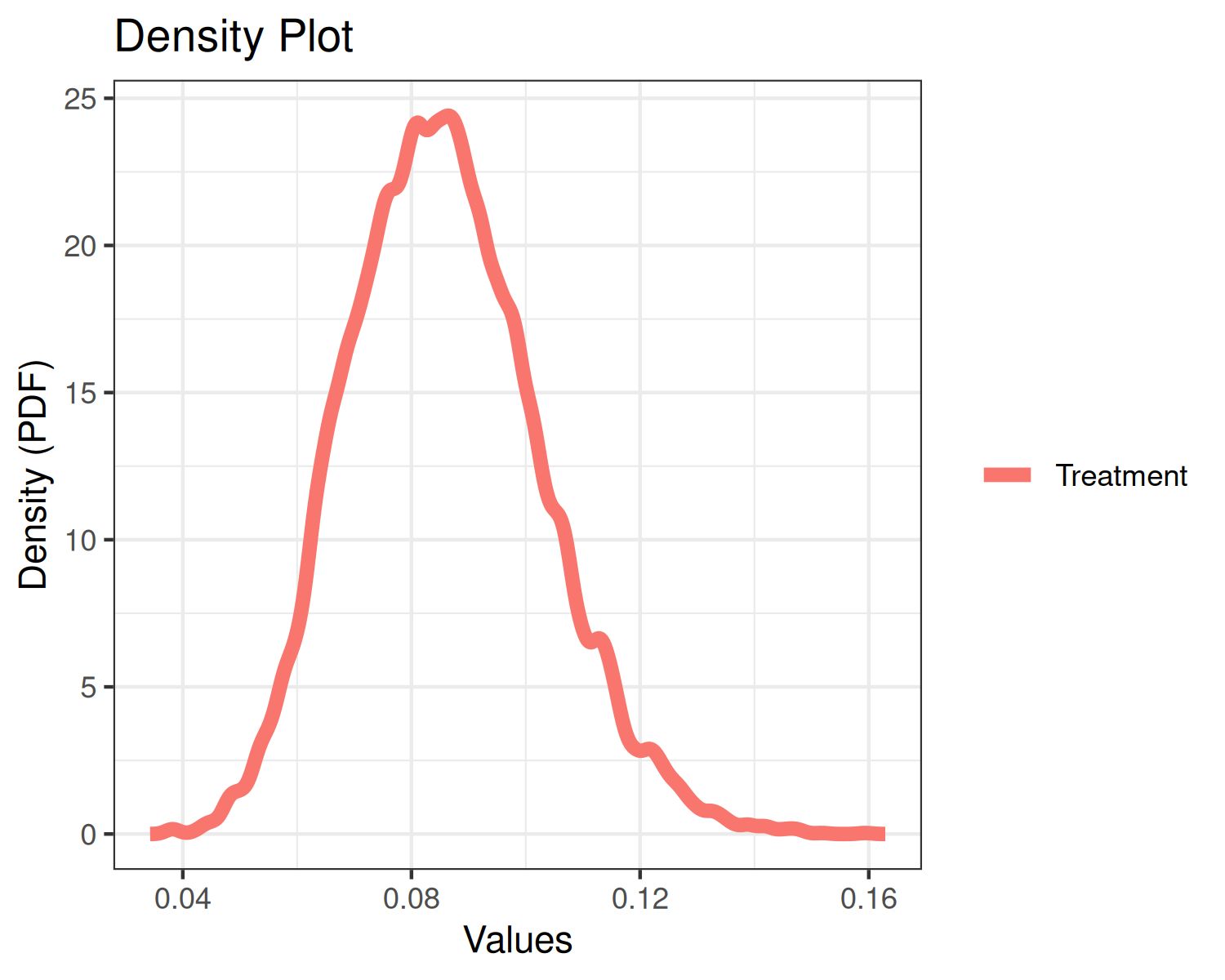
plot(fit1a, type="discount")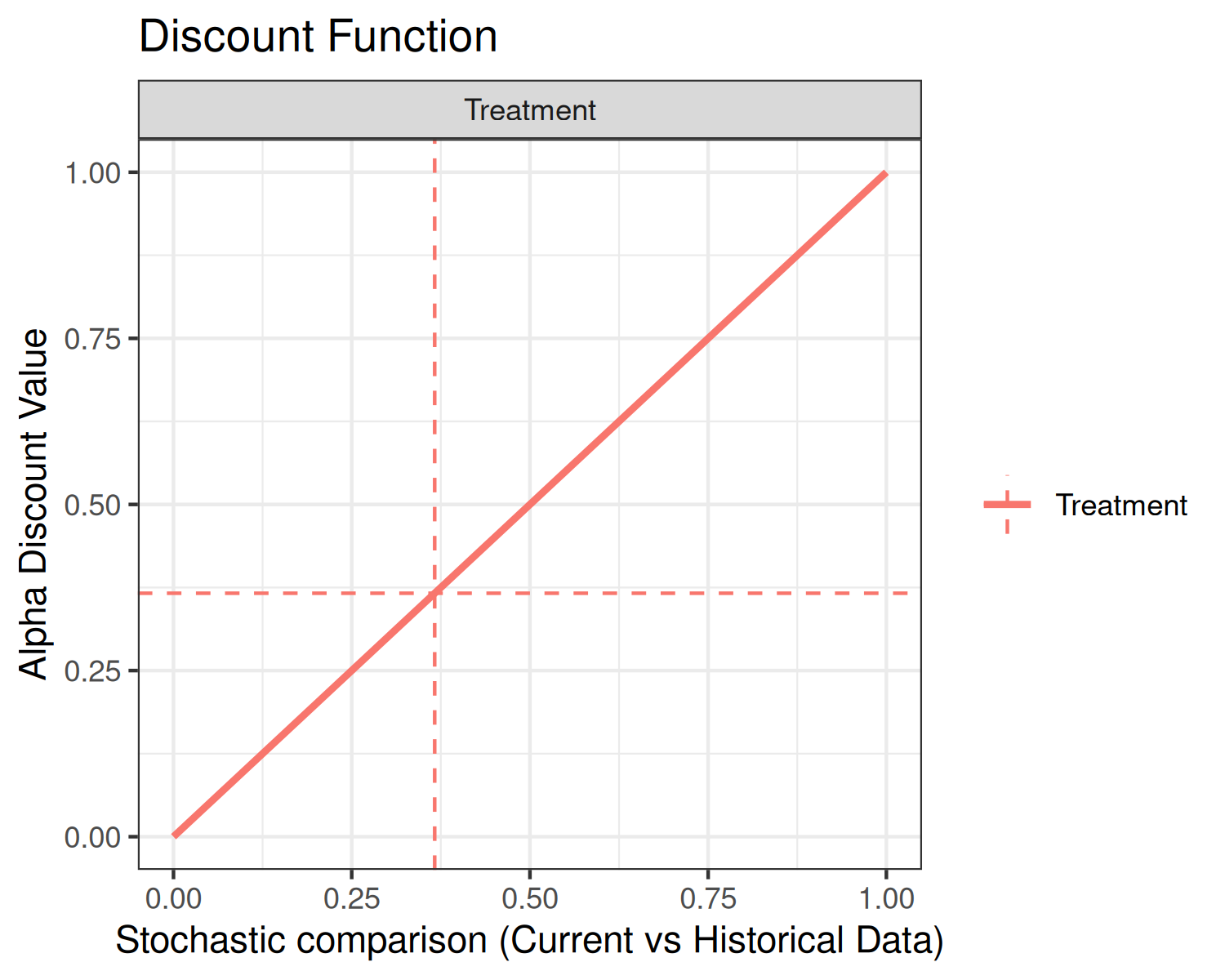
The top plot displays three density curves. The blue curve is the density of the historical event rate, the green curve is the density of the current event rate, and the red curve is the density of the current event rate augmented by historical data. Since little weight was given to the historical data, the current and posterior event rates essentially overlap.
The middle plot simply re-displays the posterior event rate.
The bottom plot displays the discount function (solid curve) as well
as alpha (horizontal dashed line) and p_hat
(vertical dashed line). In the present example, the discount function is
the identity.
Two-arm trial
On to two-arm trials. In this package, we define a two-arm trial as
an analysis where a current and/or historical control arm is present.
Suppose we have the same treatment data as in the one-arm example, but
now we introduce control data: y_c = 15,
N_c = 200, y0_c = 20, and
N0_c = 250. This control data gives a current and
historical event rate of 20/250 = 0.08.
Before proceeding, it is worth pointing out that the discount function is applied separately to the treatment and control data. Now, let’s carry out the two-arm analysis using default inputs:
set.seed(42)
fit2 <- bdpbinomial(y_t  = 15,
                    N_t  = 200,
                    y0_t = 25,
                    N0_t = 250,
                    y_c  = 20,
                    N_c  = 250,
                    y0_c = 20,
                    N0_c = 250,
                    method = "fixed")
summary(fit2)
##
## Two-armed bdp binomial
##
## Current treatment data: 15 and 200
## Current control data: 20 and 250
## Historical treatment data: 25 and 250
## Historical control data: 20 and 250
## Stochastic comparison (p_hat) - treatment (current vs. historical data): 0.3664
## Discount function value (alpha) - treatment: 0.3664
## Stochastic comparison (p_hat) - control (current vs. historical data): 0.9914
## Discount function value (alpha) - control: 0.9914
## alternative hypothesis: two.sided
## 95 percent CI:
## -0.0347 0.0453
## sample estimates:
## prop 1 prop2
## 0.08 0.08The summary method of a two-arm analysis is slightly
different than a one-arm analysis. First, we see p_hat and
alpha reported for the control data. In the present
analysis, the current and historical control data have event rates that
are very close, thus the historical control data is given full weight.
This implies that the (augmented) posterior control event rate is
approximately (20 + 20)/(250 + 250) = 0.08. Again, moderate
weight is given to the historical treatment data, so we have an
(augmented) posterior treatment event rate of 0.08.
The CI is computed at run time and is the interval estimate of the
difference between the posterior treatment and control event rates. With
a 95% CI of (-0.0347, 0.0453), we would conclude that the
treatment and control arms are not significantly different.
The plot method of a two-arm analysis is slightly
different than a one-arm analysis as well:
plot(fit2, type="posteriors")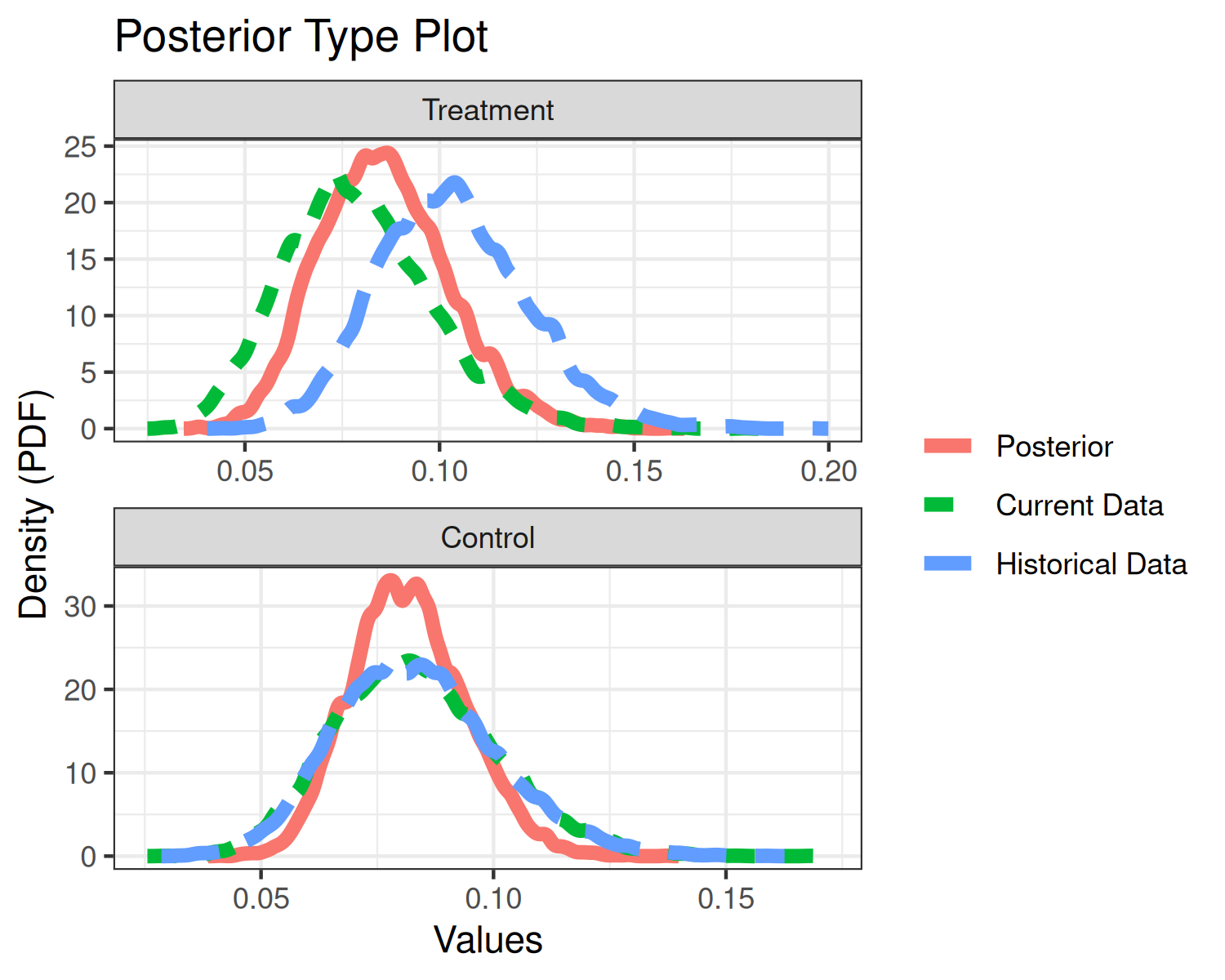
plot(fit2, type="density")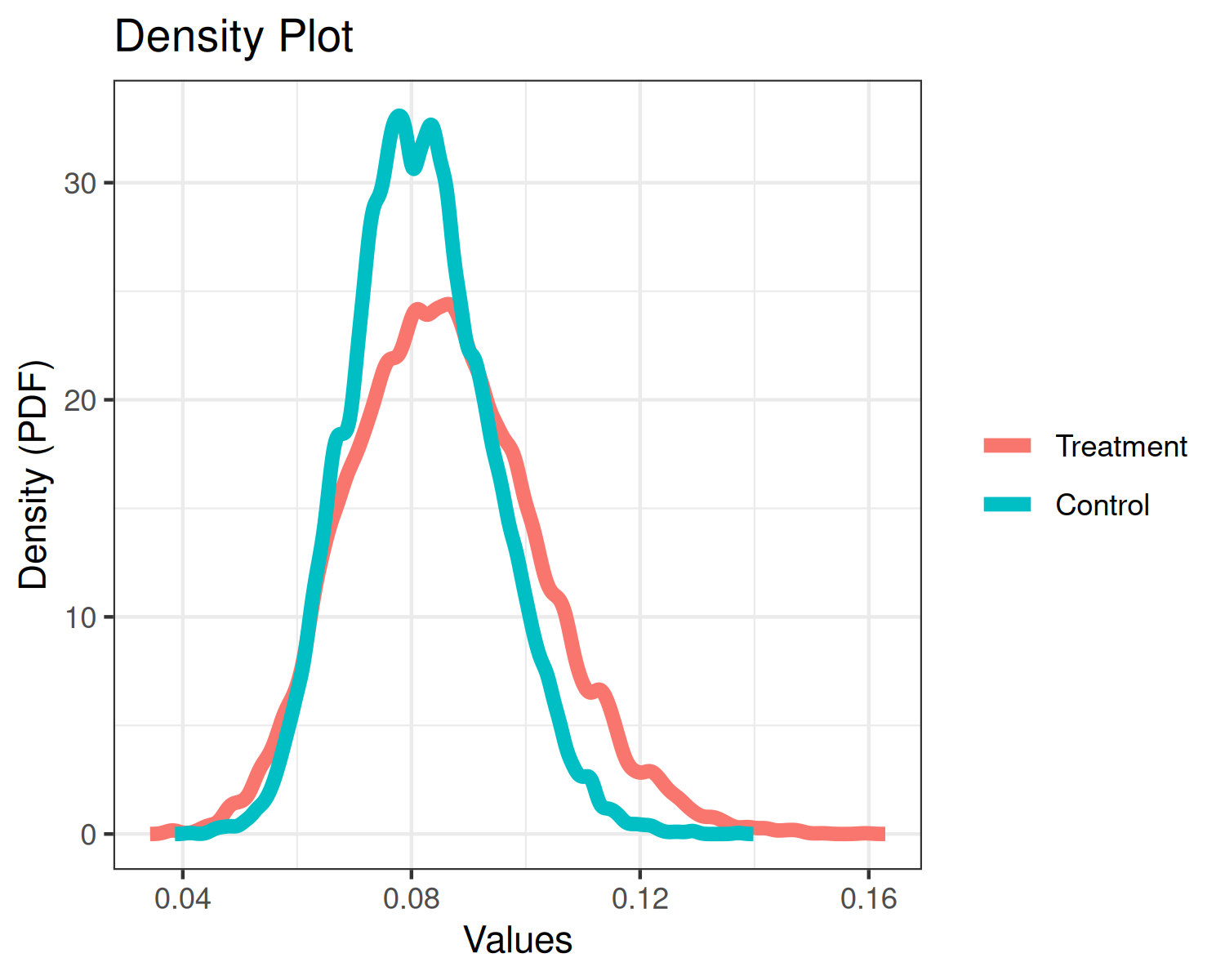
plot(fit2, type="discount")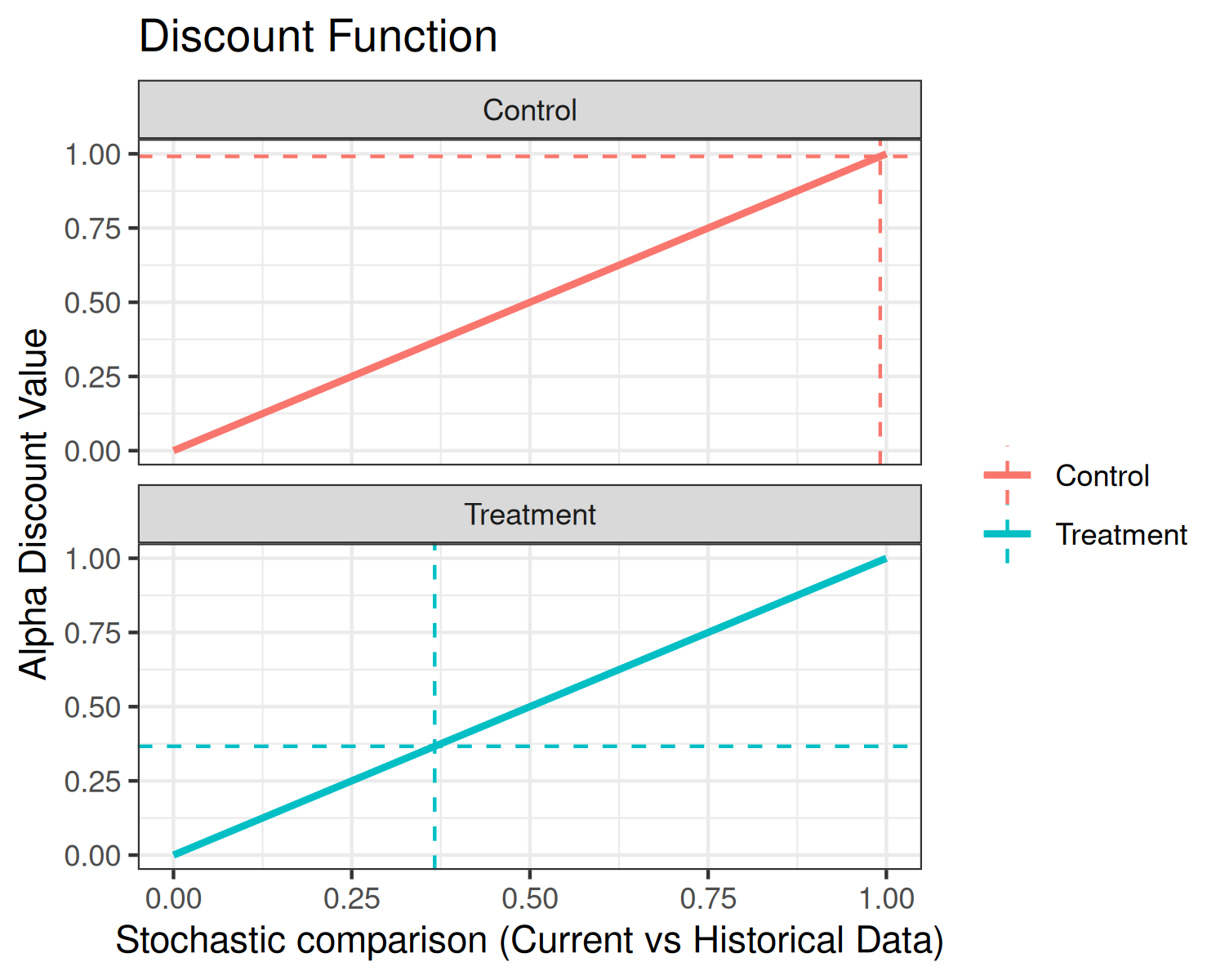 Each of the three plots are analogous to the one-arm analysis, but each
plot now presents additional data related to the control arm.
Each of the three plots are analogous to the one-arm analysis, but each
plot now presents additional data related to the control arm.